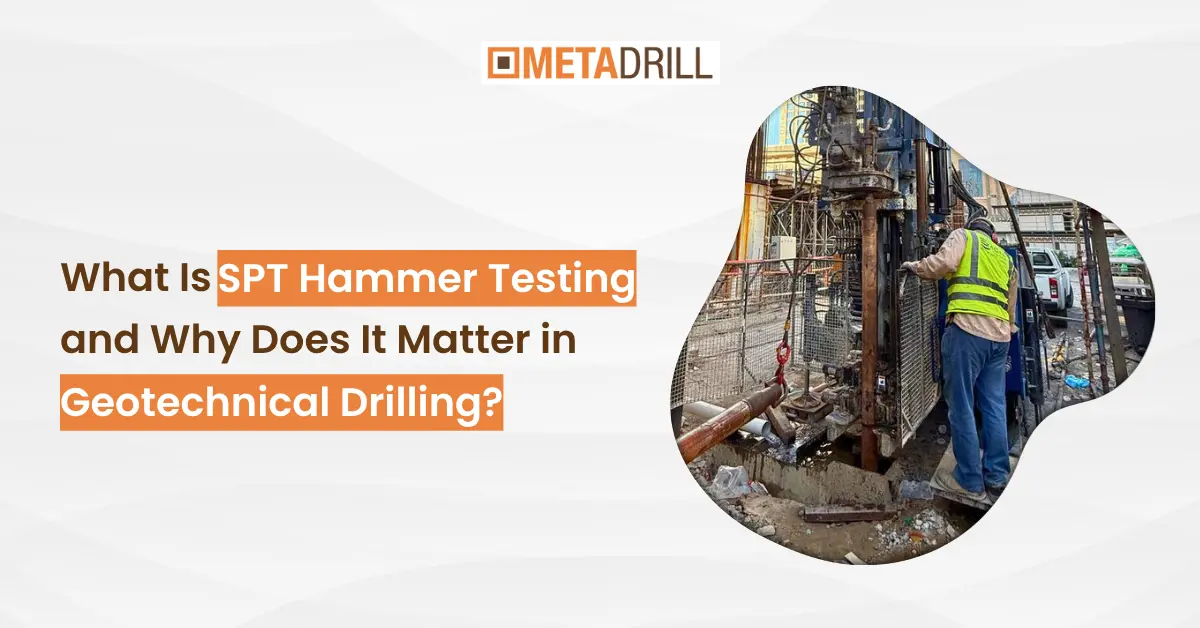
Before any construction work begins, one question always comes up on site.
“What is happening under the ground?”
From the surface, everything might look stable. The land may appear solid and ready for construction. But once drilling starts, the story often changes. One layer might be strong, the next one suddenly turns soft, and sometimes unexpected loose zones appear where no one planned for them.
This is exactly why geotechnical testing becomes important.
Engineers do not like to work on assumptions, and they want actual ground data. There is one technique that appears in many sites of a drilling among all the tests that have been employed in the process of drilling. That is called SPT hammer testing. It does not look complicated. As a matter of fact, when you come close to a drilling rig, you will notice a hammer falling up and down. However, there is more behind that uncomplicated exercise as the engineers receive insightful information that directly impacts foundation design, safety, and construction planning. This test has gained credibility over the years since it is not only effective in the theory but also in practice.
What Is SPT Hammer Testing?
SPT hammer testing is one of those methods that looks basic but gives practical results.
The crew uses a tool called a split spoon sampler, which they push into the ground using a heavy hammer. The hammer drops from a fixed height, and each drop pushes the sampler slightly deeper.
Now here is the part that really matters.
The crew does not just push the sampler and move on. The crew does not just push the sampler and move on. They count every blow carefully. This count tells them how the soil reacts.
When the sampler moves easily, the soil is loose
When it resists, the soil is dense
On site, you can actually feel the difference. In loose soil, the hammer feels like it is doing most of the work. In dense layers, you can see the resistance build up with each blow.
That number, known as the SPT N-value, becomes the key piece of data engineers use later.
So instead of guessing soil strength, the team gets a measurable response directly from the ground.
How SPT Hammer Testing Works
The process on site follows a routine, but it does not feel mechanical. Each step depends on what happened in the previous one.
The crew starts by drilling a borehole to a certain depth. They do not drill all the way down at once. Instead, they stop at intervals because they want to test the soil layer by layer.
At this point, keeping the borehole clean becomes important. If loose material stays at the bottom, it can affect the test result. So the driller takes a moment to prepare the hole properly.
Next, they lower the split spoon sampler down to the bottom.
Once everything sits in position, the hammer comes into action.
The operator lifts the hammer and lets it fall from a fixed height. Each drop pushes the sampler deeper into the soil. The process repeats, and the crew starts counting the blows.
This part usually gets everyone’s attention on site.
People naturally watch how many blows it takes. In soft soil, the number stays low. In harder layers, the count starts increasing, and you can almost sense the ground pushing back.
After the required depth is reached, the crew records the blow count. This value becomes the SPT N-value.
Then they pull out the sampler and collect the soil inside it. This sample goes into labeled boxes, and later engineers study it along with the recorded data.
Once this step finishes, the crew continues drilling and repeats the same process at the next depth.
Over time, these repeated steps build a full underground profile.
SPT vs Other Soil Tests
On most sites, SPT is not the only test available. Engineers have other options too, and each one gives different types of data.
But here is the thing.
Not every project needs highly complex testing. Sometimes, engineers need quick and reliable information while drilling continues. That is where SPT becomes the practical choice.
Test Method | How It Works | What It Measures | Speed | Cost | Best Use |
SPT | Hammer drives sampler, blows counted | Soil strength and density | Fast | Low | General site investigation |
CPT | Cone pushed with sensors | Soil resistance and layering | Fast | Medium | Soft soil profiling |
Plate Load Test | Load applied on plate | Bearing capacity | Slow | High | Foundation checks |
Vane Shear Test | Vane rotated in soil | Shear strength | Medium | Low | Soft clay |
Triaxial Test | Lab-based testing | Detailed behavior | Slow | High | Detailed analysis |
So while other tests give more detail, SPT stays useful because crews can perform it quickly without stopping the entire operation.
Why SPT Hammer Testing Matters
This test matters because it directly connects to real decisions on site.
Each blow count gives engineers a clearer idea of soil behavior. As they collect values at different depths, they start to understand where the ground is strong and where it might fail.
This understanding changes everything.
If engineers find weak soil early, they adjust the foundation design. If they detect loose layers, they plan ground improvement before construction begins.
Without this data, geotechnical drilling rig manufacturers would move forward blindly, which often leads to delays, extra cost, or structural issues later.
SPT also helps reduce surprises. Construction problems rarely happen because of what is visible. They happen because of what no one checked below the surface.
By running this test during drilling, rig manufacturers remove that uncertainty.
Another reason this method stays popular is its practicality. It does not slow down the project. Crews perform it as part of normal drilling work, which keeps everything moving smoothly.
So even though the method looks simple, the impact reaches every stage of the project.
You can also check: 9 Most Common Drill Rig Failures And The Parts That Fix Them
Final Thoughts
SPT hammer testing might not look advanced, but it plays a serious role behind the scenes.
Each hammer blow adds information. Each test point adds clarity. Over time, these small pieces help engineers build a complete understanding of the ground.
That understanding leads to better decisions, safer structures, and fewer problems during construction.
On site, many things change quickly. Ground conditions shift, drilling conditions vary, and unexpected challenges appear. But one thing remains consistent.
Crews continue to rely on SPT hammer testing because it gives answers when they need them most.
Question to the public:
Learn what SPT hammer testing is and how it works in geotechnical drilling. Understand N-value, process, and why engineers use it for soil analysis.