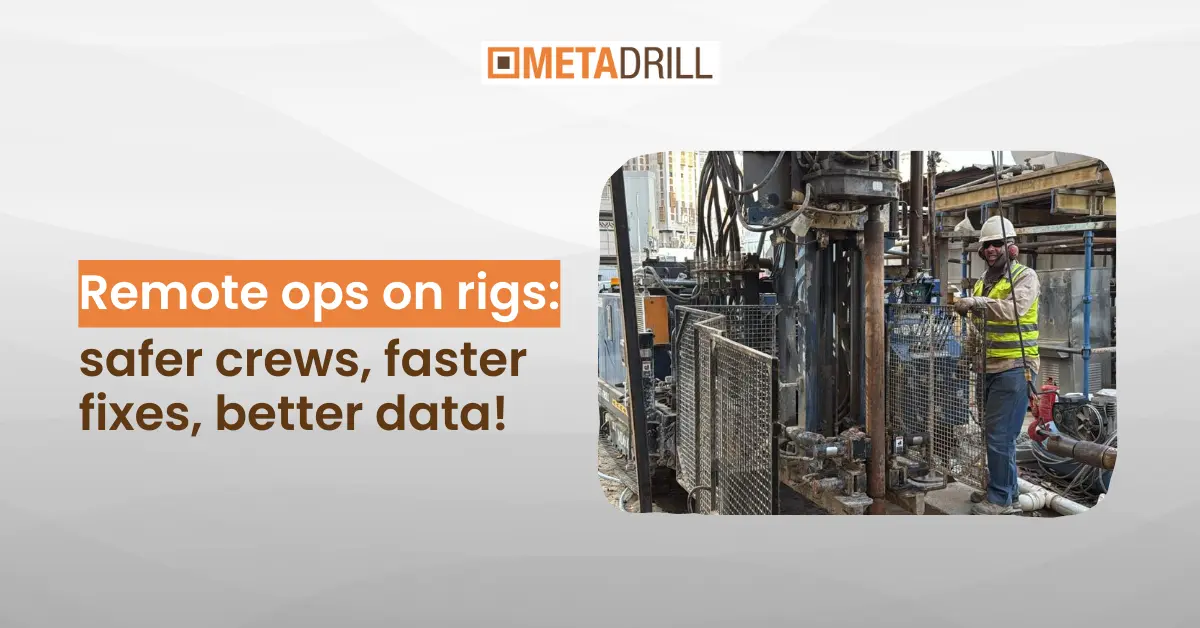
Remote operation lets experts supervise and guide a geotechnical drilling rig without crowding the pad. The result: fewer people in harm’s way, quicker troubleshooting, and better sample quality. Below is a practical blueprint, methods, and tools, along with timelines, to make remote workflows routine on any modern geotech drill rig.
What “Remote Ops” Really Means
A control room (on-site or off-site) monitors live parameters and video, coaches the crew, and, within guardrails, adjusts selected functions on the geotechnical drilling rig. For a drill rig running coring or SPT support, this typically spans visibility, advisory guidance, and limited supervised control on the rotation/feed envelope.
Why Do It in 2025?
Safety: fewer hands near rotating steel and pressurized lines.
Uptime: experts “drop in” across multiple pads to solve issues fast.
Quality: tighter control of RPM, torque, feed, and returns yields cleaner boxes, proof the geotechnical drill rig is delivering defendable data.
Consistency: parameter playbooks turn tribal knowledge into repeatable practice across your drilling rig equipment fleet.
Cross-industry evidence: a well-cited survey reported remote asset operations as the highest-ROI digital use case in oil & gas, an indicator that remote models compound value quickly.
The Three Tiers of Remote Operation
Tier 1: Remote visibility
Multi-angle CCTV on rig floor, rod handler, pumps, and returns
Live dashboards (RPM, torque, WOB, pullback, pump pressure/flow)
Data historian for trend review and post-run analysis on any drill rig
Tier 2: Remote advisory
Real-time coaching on bit selection, feed/flush adjustments, and mitigation of stick-slip or pack-off
Alarm rationalization so operators of a geotech drill rig see the few alerts that matter
Tier 3: Supervised control
Pre-set envelopes for rotation/feed
Automated tripping sequences and interlocks for safer rod handling
On-site lead retains the stop button; all changes are logged
The Tooling & Tech Stack That Makes It Work
Rig-side: instrument the machine
Sensors for torque/RPM/pressure/temp/vibration, time-synced
Clean wiring looms; sealed cabinets; dust caps on all ports
Interlocked guards and tested E-stops for the geotechnical drilling rig
Camera mounts aimed at the rod handler, returns, and drilling rig equipment
Edge & network
Hardened LTE/5G or fiber with QoS for control traffic
Edge buffer to keep data and rules alive if the link drops
Secure access (VPN, MFA, role-based rights) so your drilling tools data stays private
Control room HMI
Trends, alarms, and “last five minutes” replay
Event tags to mark stalls, vibration spikes, or recovery dips on any geotechnical drill rig
A 30-60-90 Day Rollout You Can Actually Run
Days 0–30: Visibility first
Fit CCTV and live dashboards; standardize tags across each geotech drill rig
Pilot on one shift; record baselines for RPM/torque/feed/returns
Dry-run handover: who speaks, who acts, who logs
Days 31–60: Advisory at scale
Expand to multiple rigs; tune alarms; add daily remote stand-ups (10 minutes)
Train crews on call-down etiquette and fail-safe states for the drill rig
Start a “good run vs bad run” library (video + parameters)
Days 61–90: Supervised control
Introduce guarded setpoints on one operation (e.g., feed ramp during coring)
Rehearse comms loss: prove the rig reverts to safe local control
Audit data quality; lock change management for drilling rig equipment
Field Habits That Protect People and Samples
Five non-negotiables on site
One radio channel for commands; repeat-back at critical steps
Exclusion zones painted and coned around the rotation and rod corridors
Camera hygiene, wipe lenses; eliminate blind spots on every geotechnical drilling rig
Parameter guardrails posted at the panel; log deviations with reason
Post-run review, clip video, export trends, refresh the playbook
Quality signals for the remote coach
Returns lose density or change color → adjust flushing before recovery falls
Vibration spikes → check crown wear and rod straightness; retune feed/RPM
Slipping jaws or hot rods → service drilling tools immediately
Safety Context You Can’t Ignore
Keeping people out of the line of fire is the point. In construction, there is a large number of struck-by fatalities involve heavy equipment, a reminder that de-manning the danger zone is meaningful risk reduction on any pad running a geotechnical drilling rig.
Common Pitfalls
Pitfall 1: Fancy data, fuzzy roles
Write a RACI: who watches, who advises, who commands the geotech drill rig.
Pitfall 2: Proprietary dead-ends
Pick systems that export open data; your drilling rig equipment should not trap operational history.
Pitfall 3: “We’ll automate everything”
Start small. Automate only where risk falls and core quality rises; keep the local authority clear on each geotechnical drill rig.
You can also check: Desert Maintenance Plans That Keep Rigs Working, UAE Guides
Conclusion: Make Remote Ops Your Everyday Edge
Remote workflows aren’t hype; they’re a practical way to reduce exposure, smooth performance, and defend results. Start with visibility, layer advisory coaching, and add supervised control where it’s justified. Instrument the geotechnical drilling rig, protect data paths, and train crisp handovers. Do that, and your geotech drill rig runs safer, fixes come faster, and your drilling tools produce cleaner, defendable boxes, shift after shift with modern drilling rig equipment.
Question to the public:
Make your geotechnical drilling rig safer and smarter with remote operation that cuts risk, boosts uptime, and delivers cleaner core samples every run now.