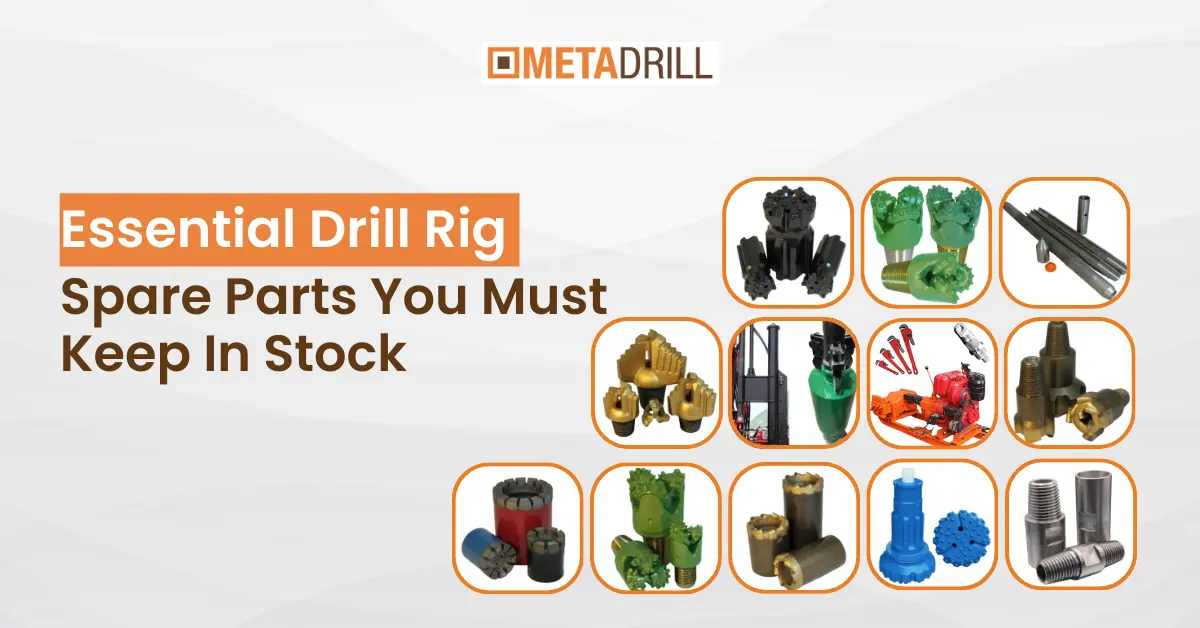
Drill rig spare parts inventory defines your operational success. Without the right components ready, your entire drilling operation stops. Consequently, smart inventory management becomes your best defense against costly downtime.
Why Spare Parts Management Impacts Your Bottom Line
Equipment failures cost drilling operations $5,000 to $15,000 per hour in lost revenue. Therefore, you need strategic spare parts stocking to protect your profits.
Unplanned downtime accounts for 35% of total drilling costs. Moreover, emergency part orders carry premium pricing and extended shipping times. Thus, maintaining proper inventory levels saves money while keeping operations running smoothly.
Three Critical Risks You Face Without Proper Inventory
Equipment Breakdown: Drill rigs operate under extreme conditions. As a result, component failures happen without warning.
Extended Lead Times: Specialized drilling parts take 4-12 weeks to arrive. Furthermore, international shipping adds complexity and delays.
Production Losses: Every hour of downtime multiplies across your entire project timeline. In addition, delayed projects damage client relationships and future business opportunities.
Rotary System Spare Parts
Kelly Bushings and Drive Components
Your rotary system powers the entire drilling operation. Accordingly, you must stock critical rotary components to prevent total shutdowns.
Kelly drive bushings wear out after 500-800 drilling hours. Additionally, formation hardness accelerates wear rates significantly. You should stock:
Two complete Kelly bushing sets minimum
Three master bushings in different sizes
One spare rotary table bearing assembly
Rotary table bearings handle massive loads continuously. Consequently, these bearings fail after 1,200-1,500 operating hours. Furthermore, bearing replacement requires specialized tools and training.
Drive Mechanism Protection
Drive mechanisms transfer power to the drill string. Therefore, worn drive components reduce drilling efficiency and increase fuel consumption.
Stock spare drive gears and coupling assemblies. In particular, inspect couplings every 500 hours for wear patterns. Moreover, damaged couplings cause vibration that destroys other components.
Hydraulic System Components
High-Pressure Hoses and Fittings
Hydraulic systems control most rig functions. Consequently, hydraulic failures stop operations immediately.
Hydraulic hoses degrade from heat and pressure cycling. Thus, you must replace hoses every 2,000 hours or annually. Stock these essential items:
10-15 hydraulic hoses in common sizes
Complete fitting assortment for quick connections
Pressure-rated hoses for 3,000-5,000 PSI systems
Temperature extremes destroy hose materials rapidly. In addition, ultraviolet exposure weakens outer layers over time.
Seals and O-Rings
One failed seal can shut down your entire operation. Therefore, you need comprehensive seal kits covering all cylinder sizes.
O-rings prevent fluid leaks throughout hydraulic circuits. Furthermore, different cylinder bores require specific seal dimensions. You must maintain:
Complete seal kit for all hydraulic cylinders
High-temperature seals for hot climate operations
Backup seals for critical safety systems
Seal failures cause contamination in hydraulic fluid. Subsequently, contaminated fluid damages pumps and valves throughout the system.
Hydraulic Pumps
Pump failures account for 25% of hydraulic system downtime. Accordingly, stock one complete spare pump assembly for your primary system.
Hydraulic pumps operate under extreme pressure. As a result, internal components wear from metal-to-metal contact. Additionally, contaminated fluid accelerates pump wear significantly.
Replace pump filters every 500 hours. Moreover, use manufacturer-specified fluids to prevent premature failures.
Mud Pump Spare Parts
Valve Assemblies and Components
Mud pumps circulate drilling fluid through your system. Therefore, valve failures stop drilling operations completely.
Mud pump valves experience the most severe wear. In particular, abrasive drilling fluids destroy valve seats rapidly. Stock these critical components:
Eight complete valve assemblies per pump
Matched poppet valves and seats
Valve springs in correct specifications
Replace valve assemblies every 200-400 hours depending on conditions. Furthermore, hard rock drilling reduces valve life by 40-50%.
Pistons and Liners
Piston assemblies and liners work as matched sets. Consequently, you must replace both components simultaneously for optimal performance.
Stock three complete piston assemblies per mud pump. Additionally, never mix worn pistons with new liners. In fact, mismatched components accelerate wear rates by 300%.
Inspect piston rubbers every 100 operating hours. Moreover, replace rubbers when compression set exceeds manufacturer specifications.
Discharge Lines and Manifolds
Discharge lines handle extreme pressure cycling. Thus, cracks develop in weld joints and connection points.
Keep two spare discharge line assemblies ready. In addition, stock complete gasket sets for all manifold connections. Furthermore, inspect discharge lines daily for visible cracks or leaks.
Pressure testing prevents catastrophic failures. Accordingly, test all pressure components at 1.5 times working pressure annually.
Hoisting System Components
Brake Assemblies
The draw works controls massive loads during drilling. Therefore, brake system failures create immediate safety hazards.
Brake bands wear from friction during load control. Consequently, you should replace brake bands every 1,000-1,500 hours. Stock these safety-critical items:
Four complete brake band assemblies
Brake lining material for emergency repairs
Hydraulic brake actuator seals
Inspect brake systems before every shift. Moreover, measure brake band thickness weekly to track wear rates.
Wire Rope and Drilling Line
Wire rope carries the entire drill string weight. Accordingly, rope inspection and replacement prevents catastrophic failures.
Replace drilling line after 300-500 drill pipe trips. In addition, inspect for broken wires every 100 trips. You must maintain:
5,000 feet of spare wire rope
Rope that matches your rig specifications exactly
Documentation of rope inspection history
Internal wire breakage occurs before external damage appears. Therefore, magnetic rope inspection detects hidden failures.
Crown Block and Traveling Block Sheaves
Sheaves guide wire rope through the hoisting system. Consequently, worn sheave grooves damage rope and reduce service life.
Stock two spare sheaves in sizes your rig uses. Furthermore, inspect sheave grooves monthly for wear patterns. Additionally, damaged sheaves create flat spots on wire rope.
Rotate sheaves every 2,000 hours to distribute wear evenly. Thus, proper rotation extends sheave life by 50-75%.
Power Generation Spare Parts
Engine Filters and Consumables
Diesel engines power most drilling operations. Therefore, you need adequate filter inventory for 500 operating hours minimum.
Stock these essential consumables:
20 fuel filters per engine
20 oil filters per engine
20 air filters per engine
Coolant and fuel additives
Replace fuel filters every 250 hours in clean conditions. However, dusty environments require 100-hour replacement intervals. Moreover, contaminated fuel destroys injection systems rapidly.
Fuel Injection Components
Fuel injection systems deliver precise fuel metering. Consequently, injector failures reduce engine power and increase fuel consumption.
Keep two spare injectors per engine on hand. In addition, stock one complete fuel pump assembly. Furthermore, fuel system parts have 2-4 week lead times when ordered.
Clean fuel prevents injector deposits. Therefore, use fuel additives in extreme temperature conditions.
Electrical Starting Components
Alternators and starters fail from vibration and heat. Thus, you must stock one spare alternator and starter per engine.
Vibration loosens electrical connections over time. Additionally, corrosion increases resistance in starting circuits. Inspect electrical connections monthly. Moreover, clean battery terminals weekly in dusty conditions.
Cooling System Parts
Overheating destroys engines within minutes. Accordingly, you need complete cooling system spare parts.
Stock one water pump assembly per engine. In addition, maintain thermostats and radiator hoses for quick replacement. Furthermore, cooling system failures cost 10-20 times more than preventive parts inventory.
Coolant mixture protects against freezing and corrosion. Therefore, test coolant concentration monthly in extreme climates.
Drilling Tools and Downhole Components
Drill Bits for Different Formations
Formation type determines bit selection and wear rates. Consequently, you need multiple bit types in your inventory.
Hard rock formations destroy bits in 20-40 drilling hours. In contrast, soft formations allow 100-200 hour bit life. Stock these essential bits:
Five tricone bits in primary hole sizes
Three PDC bits for soft to medium formations
Two diamond bits for extremely hard rock
Track bit performance by formation type. Thus, historical data guides future bit selection and inventory levels.
Drill Collars and Stabilizers
Drill collars provide weight on bit for drilling. Therefore, collar integrity affects drilling performance directly.
Stock two spare drill collars per drilling assembly. Additionally, inspect collars using magnetic particle testing annually. Furthermore, fatigue cracks develop in high-stress connection areas.
Stabilizers center the drill string in the hole. Accordingly, bent stabilizers cause hole deviation and drilling problems. Keep three stabilizers in each size you use regularly.
Fast-Moving Consumable Inventory
Filters Across All Systems
Filters protect expensive components from contamination. Therefore, adequate filter inventory prevents premature equipment failures.
Replace filters on schedule regardless of appearance. In fact, internal filter damage occurs before external signs appear. Maintain these minimum quantities:
20 hydraulic filters
20 transmission filters
15 air compressor filters
10 fuel water separators
Bypass indicators show filter condition during operation. Moreover, operating with clogged filters damages pumps and cylinders.
Lubricants and Fluids
Proper lubrication extends component life dramatically. Consequently, you must stock adequate fluids for all systems.
Keep 500 gallons of hydraulic fluid on site. Additionally, maintain 200 gallons of engine oil in correct viscosity grades. Furthermore, extreme temperatures require different fluid specifications.
Grease fittings need lubrication every 8-12 operating hours. Therefore, stock 50 pounds of high-pressure grease minimum.
Drilling Fluid Additives
Mud chemistry affects drilling performance and hole stability. Thus, you need sufficient additives for 1,000 barrels of drilling mud.
Stock these essential mud additives:
Bentonite for viscosity control
Polymers for fluid loss prevention
Barite for mud weight increases
Lost circulation materials
Formation changes require immediate mud adjustments. Accordingly, inadequate additive inventory causes drilling delays and hole problems.
Electrical System Components
Control Panel Parts
Electrical failures often occur during weather events. Therefore, you must maintain complete electrical spare parts kits.
Stock five of each critical component:
Fuses in all voltage ratings
Relays and contactors
Circuit breakers and switches
Panel indicators and meters
Label spare parts to match circuit diagrams exactly. Thus, technicians locate correct parts during emergencies.
Wiring and Connections
Vibration and environmental exposure degrade electrical connections. Consequently, you need adequate wire and connector inventory.
Keep 500 feet of wire in common gauges. In addition, stock assorted electrical connectors and terminals. Moreover, proper crimping tools ensure reliable connections.
Inspect wiring monthly for chafing and damage. Furthermore, replace damaged wiring immediately to prevent equipment failures.
Fasteners and Hardware Inventory
High-Grade Bolts and Nuts
Drilling rigs use hundreds of fastener sizes. Therefore, you need comprehensive fastener kits organized by size and grade.
Grade 8 bolts handle high-stress applications. Accordingly, stock 50 of each common size from 1/2 inch through 1.5 inches. Include matching nuts and lock washers for complete assemblies.
Torque specifications prevent fastener failures. Thus, use calibrated torque wrenches for all critical connections.
Hydraulic Fittings
Hydraulic fittings connect hoses throughout the rig. Consequently, damaged fittings cause leaks and pressure losses.
Keep 20 of each fitting type in inventory. Additionally, cross-reference fittings to manufacturer part numbers. Moreover, mixing fitting types creates leak points and safety hazards.
Thread sealant prevents hydraulic leaks. Therefore, use thread sealant on all tapered pipe threads.
Strategic Inventory Management
Criticality Classification System
Classify parts by failure impact and replacement time. Consequently, critical parts need immediate availability regardless of cost.
Critical Parts: Components that halt operations completely. Stock these items at 100% availability targets.
Important Parts: Components that reduce efficiency but allow limited operations. Maintain 85-90% availability for these items.
Standard Parts: Common consumables with short lead times. Stock based on usage rates and economic order quantities.
Safety-critical components require higher inventory levels. Thus, never substitute inferior parts in brake systems or pressure vessels.
Supplier Partnership Development
Single-source suppliers create supply chain vulnerabilities. Therefore, establish accounts with multiple suppliers for critical components.
Negotiate volume discounts and priority shipping agreements. In addition, request supplier-managed inventory programs for high-volume consumables. Furthermore, supplier partnerships reduce lead times by 30-50%.
Qualify at least two suppliers per major component category. Accordingly, backup suppliers prevent production delays during supply disruptions.
Storage Organization Methods
Organize spare parts by equipment system and criticality. Thus, personnel locate parts quickly during equipment failures.
Label all storage locations with:
Part numbers and descriptions
Stock quantities and reorder points
Equipment applications
Shelf life dates for perishable items
Climate-controlled storage protects sensitive components. Consequently, hydraulic seals and electrical parts need temperature and humidity control.
Documentation and Tracking Systems
Maintain detailed inventory records for all spare parts. Therefore, track usage rates, failure frequencies, and reorder points.
Digital inventory systems provide real-time visibility. In addition, barcode scanning automates inventory transactions. Moreover, cloud-based systems allow access across multiple drilling sites.
Update equipment-specific parts lists after modifications. Thus, inventory alignment matches actual equipment configurations.
Economic Order Calculations
Balancing Order Costs and Inventory Investment
Calculate optimal order quantities based on usage rates. Consequently, you balance ordering costs against inventory carrying costs.
Annual usage divided by order quantity determines ordering frequency. For instance, 100 hoses used yearly with 25-unit orders means quarterly ordering.
Carrying costs include storage, insurance, and tied-up capital. Therefore, these costs typically equal 15-25% of inventory value annually.
Volume Discount Strategies
Volume discounts often justify larger orders. However, you must compare total costs including discounts, shipping, and carrying expenses.
Negotiate pricing tiers with key suppliers. Additionally, combine orders across multiple rigs for better pricing. Furthermore, annual contracts lock in favorable pricing for 12-24 months.
Integration With Drilling Equipment Rental Services
Rental equipment requires different inventory strategies. Therefore, coordinate spare parts availability with your rental provider before operations begin.
Some rental agreements include spare parts coverage. In contrast, others require separate parts arrangements. Verify parts responsibility in rental contracts. Moreover, mixing rental and owned equipment parts creates accountability problems.
Rental equipment often uses different component specifications. Accordingly, maintain separate inventory tracking for rental equipment spares.
Training & Technical Solutions for Better Parts Management
Technical training reduces spare parts consumption significantly. Therefore, invest in training programs that teach proper maintenance practices.
Trained personnel identify wear patterns early. Consequently, they replace components before catastrophic failures occur. In addition, proper installation techniques extend component life by 25-40%.
Training programs should cover:
Proper installation procedures
Torque specifications and sequences
Inspection techniques and intervals
Troubleshooting common failures
Partner with equipment manufacturers for technical training. Thus, manufacturer-certified training ensures best practices.
Environmental and Seasonal Considerations
Cold Weather Operations
Cold climates require specialized spare parts. Therefore, maintain separate inventories for extreme temperature conditions.
Stock cold-weather hydraulic fluids and lubricants. Additionally, keep engine block heaters and battery warmers available. Furthermore, cold temperatures reduce battery capacity by 50-60%.
Synthetic fluids perform better in extreme cold. Accordingly, switch to synthetic hydraulics below 0°F operating temperatures.
Hot Climate Challenges
Desert operations accelerate component wear. Consequently, dust infiltration destroys seals and bearings rapidly.
Increase air filter replacement frequency by 50% in dusty conditions. Moreover, stock additional filtration components for frequent changes. In addition, dust creates abrasive wear on all moving parts.
Offshore Drilling Environments
Salt water accelerates corrosion on metal components. Therefore, stock corrosion-resistant fasteners and protective coatings.
Inspect electrical connections weekly in marine environments. Additionally, use dielectric grease on all electrical connections. Furthermore, humidity causes condensation in electrical enclosures.
Emergency Spare Parts Kits
Remote Location Preparedness
Remote drilling sites need emergency kits for quick repairs. Consequently, assemble kits containing parts for common failure modes.
Emergency kits typically weigh 500-1,000 pounds. Additionally, standard shipping containers provide weather protection. Include these items:
Critical seal and O-ring assortments
Common fasteners and hardware
Basic hand tools for repairs
Quick-connect hydraulic fittings
Test emergency kit contents annually. Thus, verify completeness and part condition before deploying to remote locations.
Helicopter-Deliverable Kits
Offshore and remote operations need air-deliverable emergency parts. Therefore, weight and volume constraints limit kit contents.
Prioritize highest-value, lowest-weight components. In addition, vacuum-sealed packaging reduces kit volume by 40%. Moreover, waterproof containers protect parts during transport.
Obsolescence Risk Management
Identifying Discontinuation Risks
Equipment manufacturers discontinue parts as models age. Consequently, you must identify obsolescence risks before parts become unavailable.
Purchase lifetime buys of critical parts before discontinuation. Additionally, engineering drawings enable aftermarket production. Furthermore, reverse engineering provides alternatives for obsolete components.
Aftermarket Parts Qualification
Aftermarket suppliers provide alternatives for obsolete parts. However, you must qualify aftermarket parts carefully before adding to inventory.
Test aftermarket parts under actual operating conditions. Thus, verify compatibility and reliability before large purchases. In addition, some aftermarket parts exceed original equipment quality.
Equipment Upgrade Strategies
Equipment upgrades sometimes eliminate obsolete parts entirely. Therefore, evaluate upgrade costs against long-term parts availability.
Upgrading old equipment reduces spare parts complexity. Consequently, newer models often use common components across multiple systems.
Quick Reference: Inventory Priority Levels
Priority Level | Description | Stock Target | Examples |
Critical | Halts operations immediately | 100% availability | Brake bands, hydraulic pumps, mud pump valves |
Important | Reduces efficiency significantly | 85-90% availability | Drill bits, wire rope, cooling pumps |
Standard | Common consumables | Based on usage rate | Filters, fluids, fasteners |
Performance Tracking Metrics
Inventory Turnover Rates
Track spare parts turnover by category. Accordingly, high turnover items need frequent reordering while low turnover indicates overstock.
Target 4-6 inventory turns annually for most consumables. However, critical safety parts may turn only 1-2 times yearly. Furthermore, slow-moving inventory ties up capital unnecessarily.
Stockout Frequency Analysis
Measure stockout frequency for critical parts. Therefore, frequent stockouts indicate inadequate inventory levels.
Zero stockouts is unrealistic and expensive. However, you should target less than 2% stockout rate for critical items. In addition, track stockout costs to justify inventory investment.
Return on Investment Calculations
Calculate ROI by dividing prevented downtime costs by inventory value. Consequently, this metric justifies inventory investment to management.
Typical spare parts ROI ranges from 300-500% annually. Thus, preventing one major breakdown pays for entire inventory investment.
Digital Inventory Systems
Real-Time Tracking Technology
Modern inventory software tracks parts automatically. Therefore, barcode scanning and RFID tags eliminate manual counting.
Cloud-based systems allow remote inventory visibility. In addition, personnel access inventory data from any location. Moreover, real-time updates prevent ordering errors and stockouts.
Predictive Analytics Applications
Machine learning forecasts parts demand based on historical usage. Consequently, predictive analytics optimize reorder points automatically.
Input accurate usage data for effective forecasting. Thus, garbage-in produces garbage-out in predictive systems. Additionally, usage patterns change over time requiring system retraining.
Multi-Site Inventory Sharing
Share inventory data between drilling rigs. Therefore, transfer parts between sites when needed.
Multi-site visibility reduces total inventory requirements by 20-30%. Furthermore, coordinate transfers during scheduled equipment moves.
Building Your Inventory Systematically
Prioritization Framework
Start with critical safety items and high-failure components. Consequently, you build inventory based on actual operational risks.
Prioritize parts using this framework:
Phase 1: Safety-critical components and high-failure items
Phase 2: Components with long lead times
Phase 3: Consumables with predictable usage rates
Phase 4: Nice-to-have items for convenience
Budget constraints require phased inventory building. Therefore, systematic prioritization ensures critical items come first.
Quarterly Review Process
Review and update inventory quarterly based on actual experience. Thus, drilling conditions change and equipment ages differently than predicted.
Compare actual usage against forecasts. Additionally, adjust reorder points based on failure patterns. Moreover, eliminate slow-moving inventory that ties up capital.
Supplier Expertise Utilization
Partner with experienced suppliers who understand drilling operations. Consequently, supplier expertise helps you select correct parts.
Request technical support from supplier representatives. In addition, suppliers often identify common mistakes before you make them. Furthermore, supplier relationships provide market intelligence on part availability.
Cost Impact Summary
Metric | Target Range | Industry Average | Your Goal |
Inventory Turnover Rate | 4-6 turns/year | 3.5 turns/year | 5+ turns/year |
Stockout Frequency | Less than 2% | 5-8% | Under 2% |
Downtime Cost per Hour | $5,000-$15,000 | $8,500 | Minimize to $0 |
Inventory ROI | 300-500% | 250% | 400%+ |
Carrying Cost | 15-25% of value | 20% | Optimize to 18% |
You can also check: Desert-Proof Maintenance for Geotechnical Rigs in the UAE
Your Path to Inventory Excellence
Proper spare parts inventory prevents downtime and reduces costs. Therefore, commit to professional inventory management as a core competency.
Your inventory investment directly affects drilling profitability. In addition, systematic inventory management extends equipment life significantly. Moreover, proper parts availability improves safety and reduces emergency repairs.
Start building your inventory today using these proven strategies. Consequently, your operations will run smoother and more profitably tomorrow.
Question to the public:
Drill rigs operate under extreme conditions. As a result, component failures happen without warning.